iSPEX2: portable water radiometry on a smartphone
A professional research sensor for above-water remote-sensing reflectance (Rrs), built around a smartphone and benchmarked in field campaigns alongside high-end ocean-colour radiometry.
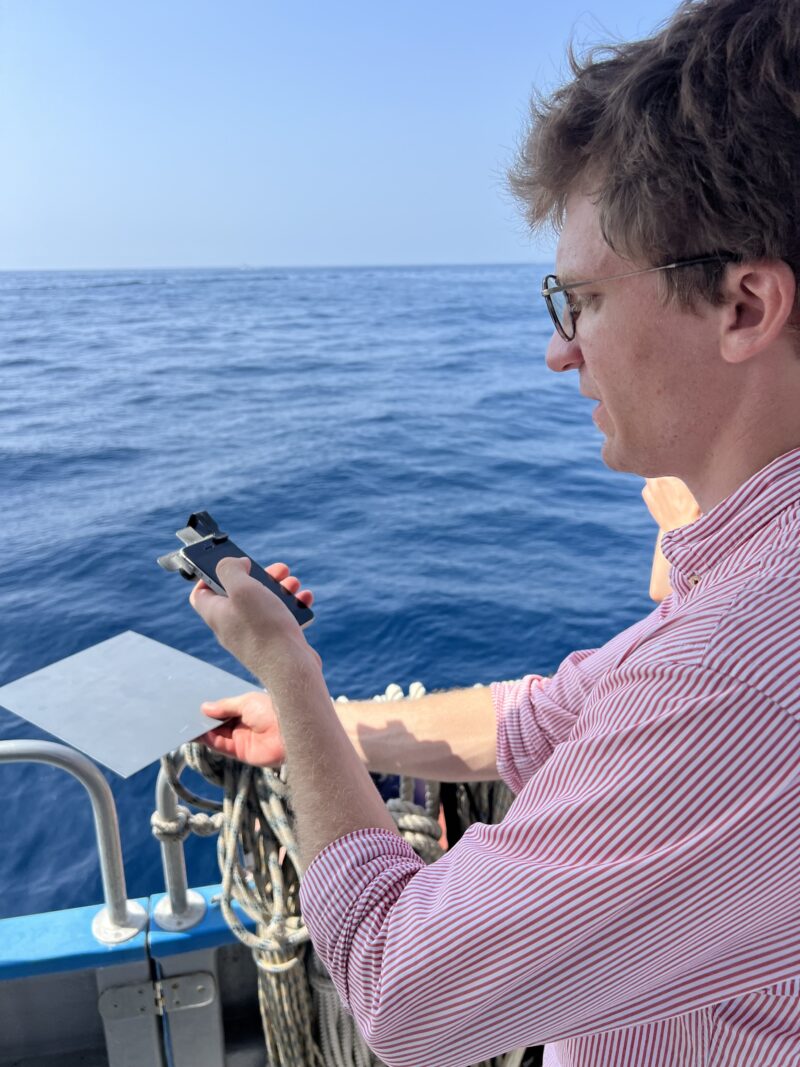
A research instrument—not a citizen-science app
- Current purpose: iSPEX2 gives professional researchers a portable route to above-water spectral Rrs using a phone, optical attachment, reference card, protocol, calibration and processing.
- Successful Rrs derivation: Prof Stefan Simis and Dr Tom Jordan at Plymouth Marine Laboratory successfully derived above-water Rrs with iSPEX2 during multiple campaigns, supported extensively by Pocket Science.
- Professional comparison: the open campaign record contains a WISP-3 reference dataset, selected So-Rad matchups and a protocol that identifies So-Rad with TriOS-RAMSES radiometers as an established ocean-colour reference route.
- Research deployment: iSPEX2 units were distributed to many research groups at the end of 2025.
- Fully distributed batch: the 2025 batch is now with research groups and no units remain in stock. New orders require a funded production route.
- Air-quality boundary: air-quality use has not been implemented or validated for iSPEX2. Atmospheric citizen-science evidence belongs to iSPEX1.
What the professional comparison means
iSPEX2 was created as a smartphone-based route to water-reflectance measurement alongside established ground-based radiometers. Its aquatic campaign pairs phone measurements with synchronous reference radiometry and preserves the observations and processing artefacts for inspection.
That supports a clear claim: iSPEX2 can produce useful above-water Rrs in a professional workflow and can be compared directly with established systems in tested campaigns. It does not mean the hardware is universally interchangeable with WISP-3, So-Rad or TriOS-RAMSES across every condition; automation, calibration traceability, spectral range and deployment model differ.
Where iSPEX2 fits in water-quality research
Remote-sensing reflectance helps researchers study optically active water constituents, including signals associated with algal pigments. That makes iSPEX2 relevant to water-quality sensor searches while keeping the scientific claim precise: it measures spectral reflectance through a defined above-water method. It is not a universal pollution detector, drinking-water safety test or direct replacement for chemical and microbiological analysis.
The scientific route
The dedicated scientific identity, history and documentation live at ispex.org. iSPEX originated at Leiden University. Pocket Science developed the iPhone implementation and contributed the apps, backend, processing, distribution and deployment. Prof Stefan Simis and Dr Tom Jordan at Plymouth Marine Laboratory led the successful above-water Rrs work across multiple 2025 campaigns, with extensive technical support from Pocket Science. The iSPEX research hub connects the 2014 iSPEX1 campaign paper, SPECTACLE camera calibration, the 2020 iSPEX2 instrument paper, 2022 above-water smartphone radiometry and the open aquatic-validation record.
Validation of one method does not imply universal phone compatibility, unit equivalence or readiness for every proposed use. Camera processing, geometry, exposure, references, calibration, optical alignment and construction can materially affect results.
Support for an existing iSPEX unit
If your research group received an iSPEX or iSPEX2 unit, include the hardware generation, phone model, app and version if known, intended measurement, protocol followed and the specific problem when contacting us. This helps route the question to the right technical or scientific partner.
Existing units are research instruments, not a standard supported consumer product. New calibration, software changes or project-specific analysis may require a funded scope. Do not send confidential research data, personal participant information or unpublished results through the public contact form.
- iSPEX2 research and publications
- Preserved iSPEX2 documentation, campaign files and processing archive
- Scientific iSPEX website
- Original OSF iSPEX2 project
- Preregistered aquatic-reflectance validation study
- Historical iSPEX campaign map
- Contact Pocket Science
The investment opportunity
Pocket Science is actively looking for the funded research, investment and production opportunity that can make iSPEX2 consumer-ready. The ambition is a distributed citizen observatory: many people measuring water with the validated Rrs method and, after implementation and validation, extending the same instrument concept to atmospheric observation. Interested scientific, institutional and investment partners can start a conversation.
Planning a different citizen science project?
A new project does not need to use iSPEX, a sensor or a complete observatory. Pocket Science develops tailor-made citizen science apps, scientific sensing workflows, data services and long-term research infrastructure around the method actually required.